NSF invests $40M to strengthen STEM research capacity and workforce development across five EPSCoR jurisdictions
The U.S. National Science Foundation is investing approximately $40 million to support research and STEM workforce development in Delaware, Guam, Kentucky, Louisiana and Vermont. These grants are part of the NSF Established Program to Stimulate Competitive Research (NSF EPSCoR), which aims to bolster research competitiveness among 28 targeted states and territories, referred to as jurisdictions.
“EPSCoR is a driving force in enabling STEM research for everyone, everywhere, ensuring broad access to innovation and opportunity,” said NSF Director Sethuraman Panchanathan. “This cohort of E-CORE projects exemplifies the transformative power of investing in research infrastructure, and their contributions are poised to generate a lasting, sustainable impact on these jurisdictions’ research ecosystems.”
Through these projects, awardees will help drive scalable impacts that align with EPSCoR goals. The projects will promote research with practical benefits, boost economic growth and address research infrastructure gaps in areas that have historically received less funding, supporting innovation, technology and education across the U.S. and its territories.
The awardees and summary of each project are listed below:
E-CORE RII: Strengthening Partnerships for Advancing Research Capacity in DelawareLed by the University of Delaware, this project’s vision is to create an inclusive, open, collaborative research ecosystem as well as to train and retain a highly skilled workforce. The project focuses on strengthening the state’s data and intellectual property infrastructure, improving communication and access to STEM programming, supporting entrepreneurial training and fostering cross-institutional collaborations. By addressing these needs, this project will boost cutting-edge research carried out by interdisciplinary teams, resulting in substantial gains in Delaware’s knowledge-based economy.Collaborating institutions: Delaware State University, Delaware Technical and Community College, and Goldey-Beacom College.
E-CORE RII: Optimizing Research Infrastructure in GuamLed by the University of Guam, this project will build networks within Guam’s research ecosystem to promote and support the development of competitive scientific research. The project will manage and coordinate research ecosystem growth to support improvements to jurisdictional research infrastructure. Additionally, it will support the training of a diverse STEM workforce ready to engage with emerging economic opportunities driven by scientific research and development. Through organization of workshops and strategic planning activities with Guam’s stakeholder community, the project aims to identify areas and opportunities for growth, foster and strengthen partnerships and promote efforts to secure external funding to strengthen the territory’s capacity for scientific research. The project will provide project development as well as management and administrative support for these efforts to grow and strengthen Guam’s research ecosystem.Collaborating institution: Guam Community College.
E-CORE RII: Technology for Innovative Visualization, Aggregation & Training in Environmental Preparedness and Resilience for Kentucky
This project, led by the Kentucky Science & Technology Corporation, aims to expedite solutions to existing and rising challenges in climate resilience in Kentucky by increasing the capacity and connectivity of the research ecosystem throughout the state. Project outcomes will reduce the potential for damage and preserve life, develop new technologies, contribute to economic growth and job creation and build a more climate-resilient and prosperous future for all Kentuckians.Collaborating institution: Kentucky State University.
E-CORE RII: Louisiana Networks of Excellence for TomorrowLed by the Louisiana Board of Regents, this project aims to build and sustain strong networks of collaboration, communication and partnership among the jurisdiction’s institutions of higher education, connecting all stakeholders to the various resources, facilities and opportunities available in the state. Additionally, key project activities will include mentoring programs, competitive graduate student scholarships and fellowships and K-12 outreach activities.Collaborating institutions: Louisiana State University and A&M College, Louisiana Tech University, Southern University and A&M College and the University of New Orleans.
E-CORE RII: The Science and Technology Research Initiative for the Vermont EconomyThis project, led by Landmark College, aims to build an inclusive research ecosystem to serve as a cornerstone of the Vermont economy. The project’s goal is to establish administrative support to build and sustain a diverse, integrated science and technology research ecosystem in Vermont. The project also aims to expand opportunities in STEM education and research for students who are neurodivergent, first-generation, low-income or multilingual, in order to ensure opportunities for all talented students. The project will build research capacity through training, increasing research opportunities and creating new science and technology jobs. It will contribute to expanding the science and technology workforce locally and nationally.Collaborating institutions: Bennington College and Community College of Vermont.
UD’s Jungfleisch wins NSF CAREER Award for brain-inspired tech
The human brain is an astonishing organ, as any neuroscientist can attest. And its ability to collect, store, analyze and use information is intriguing to physicists, engineers and computer scientists, too.
Benjamin Jungfleisch, associate professor of physics at the University of Delaware, is among them.
Jungfleisch, who joined UD’s faculty in 2018, is an expert in magnon spintronics. He uses lasers to explore the dynamics of magnetic nanostructures — tiny magnets that can be used to store and steer information through a circuit.
A primary focus of his work now is finding brain-inspired ways to develop low-energy computing, using interacting nanomagnets as the command center.
Neurons are the brain’s information processors, with electrical and chemical signals carrying information between neurons. In a similar way, magnons — the fundamental quantum excitations that make up “magnetic waves” or “spin waves” in a magnetic system — perform a similar process through arrays of magnetic nanostructures, carrying and processing information in ways that could lead to faster, more energy-efficient processing and even artificial intelligence (AI) devices.
This addresses a critical need, especially now as the energy consumption of AI is skyrocketing. AI has extraordinary potential for our world. But its complexity requires intensive computing power and an ever-increasing number of data centers to manage and meet the computational demand. Without innovative solutions, energy will be an increasing problem for society, industry and the climate.
The National Science Foundation has recognized the significance of Jungfleisch’s work with a 2024 CAREER Award, a five-year grant worth just over $798,000, to support his research team’s efforts to develop low-power computing and processing methods using these magnetic nanostructures. The project also is supported by the Established Program to Stimulate Competitive Research (EPSCoR).
Jungfleisch works with nanomagnetic arrays, which can be compared to the brain’s neural networks, the pathways used to move signals along. Magnon connections are akin to the “synapses” that transmit signals along specific circuits.
“These arrays of interacting nanomagnets are essentially just tiny bar magnets,” Jungfleisch said, “like the ones you have on your fridge and the ones children play with. They have a north and a south pole. And if you make them very small — on the nanometer scale — you can pattern them with state-of-the-art lithography, which we have available here.”
When Jungfleisch says “tiny,” he is talking about things you cannot see with your eyes. Nanoscale structures are measured in nanometers. It takes more than 25 million nanometers to make one inch. Much of the work is done in UD’s Nanofabrication Facility, headquartered in the Patrick T. Harker Interdisciplinary Science and Engineering (ISE) Laboratory.
“You can make lattices out of them and they interact,” he said. “They can store information — very similar to what the neurons do in our brain. And the neurons are all connected in a network. So we place these nanomagnets in a network and they feel each other.”
Traditional computers use a processor and memory.
“Data is constantly shuffled between the two and it’s highly inefficient,” Jungfleisch said.
Devices using interacting nanomagnets offer multiple advantages.
“These structures can do it all,” he said. “We do not need electrons, because we use magnetic excitations. And second, we can do processing and storage at the same time in the same unit.
“There are specific tasks such as artificial intelligence where this may be useful — what we do with ChatGPT, for example, or recently emerging chatbots for creating images.”
These nanomagnet networks can be trained, Jungfleisch said. They keep a history and remember the state they are in, but they also need to be susceptible to change and retraining — neuromorphic changes, they are called.
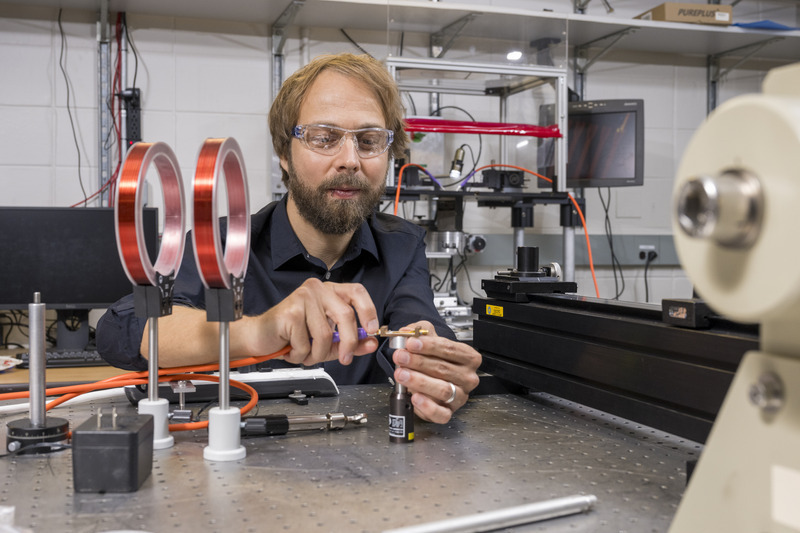
Benjamin Jungfleisch, associate professor of physics at the University of Delaware, uses this model of macroscopic spin-ice with permanent magnets to introduce magnetic interactions and phenomena to broader audiences. In his research, Jungfleisch uses tiny magnets — at the nanoscale — to study the dynamics of their interactions. This model was developed with support from the American Physical Society’s Magnetism Outreach Program.
Jungfleisch’s primary collaborator — Jack Gartside, a physicist at Imperial College in London — had a breakthrough in 2022, using effects Jungfleisch discovered in 2016 related to this hysteretic behavior and realized the network could be trained and predictions about the future could be made.
In the future, Jungfleisch said, training cycles that now require two or three hours to complete could take minutes, using novel phenomena such as spin torque.
Learning about these interactions and how to manipulate and tune them for specific purposes is critical to Jungfleisch’s CAREER project, which will address four important challenges:
Controlling magnons in two-dimensional arrays of nanomagnets
Manipulating magnon-magnon interactions
Increasing knowledge of the dynamics in magnetic nanostructures
Demonstrating these next-generation neuromorphic concepts experimentally
Two recent publications in Nature Communications by Jungfleisch and collaborators explain progress made recently in magnon-magnon coupling and nonlinear dynamics.
Three-dimensional work is underway and advancing quickly, Jungfleisch said.
The more recent publication describes a three-dimensional nanomagnetic structure that improves performance over two-dimensional arrays and requires simple fabrication and measurement techniques that are widely available. Among the advances are the demonstration that a three-dimensional magnonic material can be stacked with independently programmable magnetic nanostructured systems.
“You get many more states in your system and a much smaller footprint,” Jungfleisch said. “Storing more information in these networks is easier since you have more space available. Who doesn’t want more neurons?”
You also get more flexibility.
“This gives you a lot of reconfigurability,” Jungfleisch said. “You can change the dynamics of the synaptic behavior as well as the memory.”
Nonlinear dynamics also emerge as interesting phenomena in these networks. For example, Jungfleisch found that one magnon can split into two or two magnons can merge into one in these structures. This provides the foundation for parallel computing and information processing.
“We’ll use this phenomenon to improve the function of the neuromorphics,” he said.
Many questions remain, including how to create and manage randomness and disorder in these systems.
During his upcoming sabbatical, Jungfleisch plans to continue his work with research groups in Germany and India.
And later, as part of his CAREER Award project, he plans to develop a five-week introductory course on magnetism and electricity for adults in UD’s Osher Lifelong Learning Institute and create a wave machine demonstration that would make spin waves visible using an infrared camera. He also wants to develop a wave machine demonstration — using barbeque skewers, duct tape and gummy bears — that would be accessible to students with various disabilities. That device would be available for loan to science teachers in local middle schools and high schools.
About the researcher
Benjamin Jungfleisch is an associate professor of physics at the University of Delaware, whose research covers condensed matter physics, materials science, spintronics, magnonics, nanomagnetism, spin transport phenomena and spin dynamics. Before joining the UD faculty in 2018, he was a postdoctoral researcher at Argonne National Laboratory’s Materials Science Division. He received his Ph.D. and master’s degree in physics from the University of Kaiserslautern, Germany. He received the U.S. Department of Energy’s Early Career Research Award in 2019 and a National Science Foundation EPSCoR RII Track-4 Fellowship in 2018.
Article by Karen B. Roberts Photo by Kathy F. Atkinson
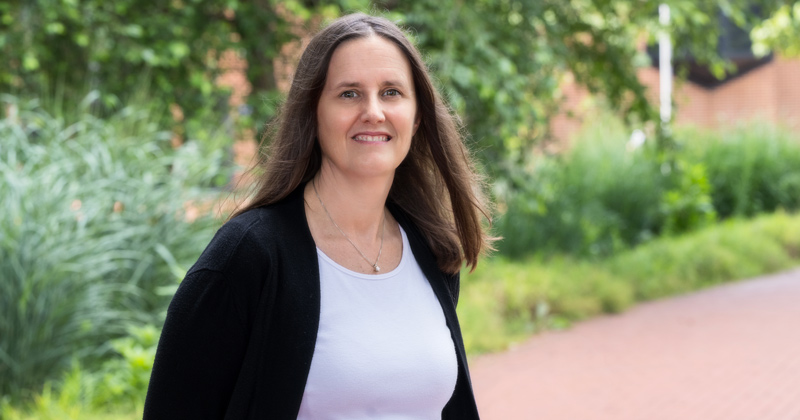
Amy Slocum is the newly appointed director of the Delaware Established Program to Stimulate Competitive Research.
EPSCoR is a federal-state partnership sponsored by the National Science Foundation (NSF) that engages Delaware’s academic institutions in cutting-edge research and training activities that address critical needs of the state. Delaware was designated an EPSCoR state in 2003, and the program supports activities at its partner institutions — the University of Delaware, Delaware State University and Delaware Technical Community College.
The statewide appointment, headquartered at UD, was announced by Kelvin Lee, UD interim vice president for research, scholarship and innovation. It is effective August 15.
Slocum previously served as associate director of EPSCoR and as assistant director of the Delaware Environmental Institute (DENIN). She succeeds Don Sparks, Unidel S. Hallock du Pont Chair in Plant and Soil Sciences at UD, who served in the role from 2012-2023.
“EPSCoR has been a critical force for Delaware, building research infrastructure, fostering collaborations across campuses and preparing new generations of students for the workforce,” said Lee. “Dr. Slocum brings a national reputation in program development and administration, competing for and managing large-scale, interdisciplinary grants at the federal level. As my colleagues at DSU and DelTech and I look forward to working with her, we also want to express our deepest gratitude to Don Sparks for his leadership and dedication over the past 11 years.”
With a background in public administration, Slocum has managed hundreds of millions of dollars in grant funding over the last 25 years. She is well-known for working with state partners, faculty and federal and state funding agencies, such as the National Science Foundation and the Department of Defense, to empower research in the First State.
“Amy understands EPSCoR, its goals, expectations and processes better than anyone in Delaware,” said David Small, chair of the State EPSCoR Committee. “In her role as associate director, she has provided invaluable support and innovative leadership for a wide array of EPSCoR stakeholders, including researchers, private and public sector partners, students, administrations of our participating academic institutions and the state committee. EPSCoR has been a significant force in helping Delaware achieve its science and technology goals, and Amy is absolutely the right person to lead the program to future success.”
While housed within DENIN, much of Delaware EPSCoR’s work centered around the environment, including advanced research on complex environmental systems, ecosystem health, sustainability, water and energy. Now a unit of the University’s Research Office, the program, Slocum hopes, will expand its focus to include engineering and agricultural sustainability, in alignment with the state’s current science and technology needs. She also looks forward to developing new initiatives as the national program refines its mission and to supporting other large interdisciplinary grants across UD’s campuses.
Slocum earned her doctorate in educational leadership, administration and policy and a master’s degree in public administration at the University of Delaware. She is a member of the National Council of University Research Administrators and a frequent panel reviewer for NSF funding proposals related to accelerating research translation, research infrastructure improvements, manufacturing innovation and more.
Bringing multiple minds — and voices — together to solve large-scale challenges facing Delawareans is one of the things Slocum enjoys most.
“Issues are multifaceted, and you could miss something if you don’t have the right people at the table,” Slocum said. “EPSCoR is a connector. We create opportunities to reach out to the stakeholders, have conversations and engage communities and members of industry, businesses and academia to understand what research can do and how it can help. This contributes to a brighter future by putting Delaware and the United States on the map in terms of leading-edge science and solutions.”
To date, Delaware’s EPSCoR program has resulted in $101 million in direct EPSCoR funding to the state and $139 million through leveraged EPSCoR funds and 293 additional research, education and innovation awards to EPSCoR faculty. This work has led to the development of 75 patents, 17 new products and 5 new businesses, as well as 25 new faculty hires.
Developing the workforce of the future is another key part of the EPSCoR program. Through multi-level mentoring, best-practices are passed along from faculty to next-generation scientists — postdoctoral researchers, graduate and undergraduate students — to help meet the needs of today, while seeding scientists to address the needs of tomorrow. Since the program’s inception, Delaware EPSCoR has engaged over 1,600 students with the potential to become future environmental leaders, including 45 graduate fellows that have gone on to positions as university faculty, start-up business owners and as scientists in government agencies and foundations, such as the U.S. Environmental Protection Agency, National Science Foundation, National Oceanic and Atmospheric Administration and the Charles Stewart Mott Foundation.
Delaware EPSCoR is accepting applications for summer research internships. Applications for the 2019 EPSCoR Summer Scholars research internship program for undergraduates are now being accepted via an online form and are due by 5 p.m. on Friday, March 15.
The Delaware Established Program to Stimulate Competitive Research, or EPSCoR, has funded more than 350 undergraduate research internships at
the University of Delaware, Delaware State University, Wesley College and Delaware Technical Community College since 2004.
The program takes place over a 10-week period in the summer beginning in June. In addition, to completing an independent research project, interns
participate in skill-building seminars on such topics as attending graduate school, research ethics and making a research presentation.
EPSCoR Summer Scholars typically present their work via posters or presentations at UD’s Undergraduate Research and Service Scholar
Celebratory Symposium, held in August. Interns also receive a stipend of $4,000.
Rising sophomores, juniors and seniors are eligible. Students with an interest in climate, sea level rise, water quality, land use, soil contamination
and remediation, environmental sensing and monitoring, economics, ethics, or environmental policy are especially encouraged to apply. Students can
review specific projects being offered this summer as well as the specific start date on our new EPSCoR WiCCED website https://projectwicced.org/resources/.
EPSCoR is a federal-state partnership sponsored by the National Science Foundation (NSF) that engages Delaware’s academic institutions in cutting-edge research and training activities that address critical needs of the state. The new grant is the fourth EPSCoR Research Infrastructure Improvement (RII) grant awarded to Delaware since its designation as an EPSCoR state in 2003. The award supports activities at the four partner institutions — the University of Delaware, Delaware State University, Delaware Technical Community College and Wesley College.
The state of Delaware is contributing $3.8 million of the overall grant through matching funds over the next five years. Delaware Gov. John Carney offered his congratulations to those in attendance at the event, held at Delaware State University, reflecting on EPSCoR’s humble beginnings from an experimental program to the established program today that “has taken root in our state” to address problems such as water quality, increased salinity and other challenges related to climate change.
Carney noted that Delaware is investing in EPSCoR because of the program’s efforts to build up the state’s research expertise and workforce for future jobs.
“EPSCoR encourages and insists on collaboration,” Carney said. “It is a way to build capacity so that we can develop that workforce here in the state of Delaware to address these important issues so that our economy can be stronger in the years ahead.”
Delaware U.S. Senators Thomas Carper and Chris Coons also spoke. Carper, ranking member of the Environment and Public Works Committee, called EPSCoR “the kind of program that is a good example of what we do well in Delaware: Communicate, collaborate and compromise,” adding that he is particularly interested in the research aimed at sea level rise, the effects of land use and climate change. “Delaware can be a leader in these areas,” said Carper.
Coons, a member of the Appropriation Committee, reminded the audience of Delaware’s history and connection to the coast and its resources.
“This funding will support critical research focused on keeping Delaware’s water safe and protecting our coastal environment,” Coons said. “It’s exciting to hear about how the entire scientific community — students, researchers, current and future workers—is helped by this. This is not just a vehicle for doing great research, it’s also a vehicle for training and developing and deploying the next generation who will do the lab work, design work, who will scale things up and deliver solutions to the problems.”
Leaders from all four Delaware EPSCoR partner institutions — Donald Sparks, Delaware Environmental Institute director at UD, DSU President Wilma Mishoe, DTCC President Mark Brainard, and Wesley College President Robert Clark — described the impact that the EPSCoR program has had on institutional growth, student access and learning, and community partnerships over the past 15 years.
To date, Delaware’s NSF EPSCoR program has resulted in $69 million in direct EPSCoR funding to the state and $82 million through leveraged EPSCoR funds and 212 additional research, education and innovation awards to EPSCoR faculty.
Delaware EPSCoR’s Kent Messer, the project director and the S. Hallock du Pont Professor of Applied Economics for the Environment in UD’s College of Agriculture and Natural Resources, presented the “Water in a Changing Coastal Environment” project (Project WiCCED) and its overarching goals for the next five years of funding.
“History has shown that environmental problems can be solved when people work together and when cost-effective policies are enacted that are informed by good science,” Messer said. “Project WiCCED will bring together some of the brightest minds, most dedicated people and most promising students to improve the water quality, step-by-step (or drop-by-drop) for a better future that Delawareans all can enjoy.”
A major thrust of future work will focus on salinization, or the increasing salt content in water or soil, which degrades water quality. Delaware’s long tidal shoreline and low elevation make its waters vulnerable to salinization, a problem made worse by rising sea levels and groundwater withdrawals for industry, agriculture and municipal use.
“Salt is bad for drinking water and our freshwater habitats,” said Holly Michael, co-principal investigator and research lead on the WiCCED project. Michael also is the Unidel Fraser Russell Chair for the Environment and UD associate professor in the Department of Geology, which is housed in the College of Earth, Ocean and Environment. “Increasing salinity could also aggravate existing water quality problems by triggering release of polluting nutrients and industrial contaminants currently bound in the soil.”
At UD, this latest round of funding will enable the hiring of two new faculty members in key research areas of human-natural systems modeling and hydrologic systems modeling, as part of a broader University cluster hire in coastal water security that includes environmental toxicology and remediation. These new positions will enhance university research and benefit students with interests in these areas, Michael said.
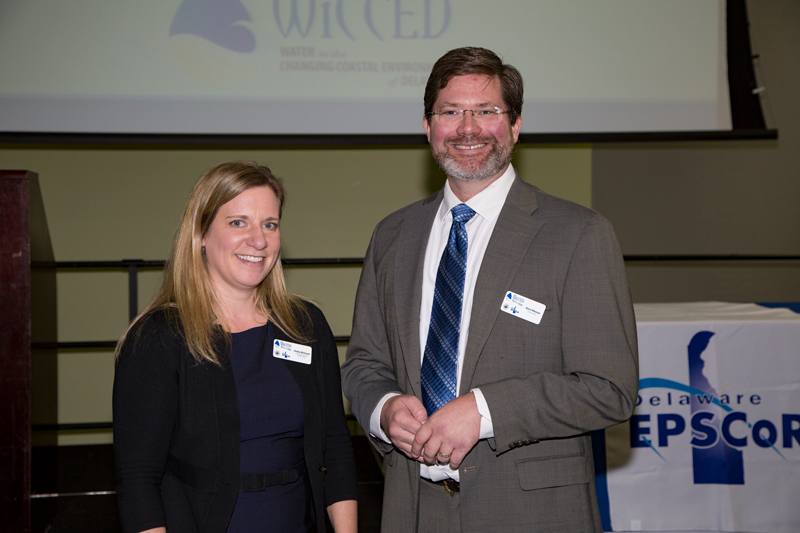
UD professors Kent Messer and Holly Michael will lead work on the latest EPSCoR project, “Water in a Changing Coastal Environment.” Messer is the Delaware EPSCoR project director and Michael serves as co-principal investigator and research lead.